
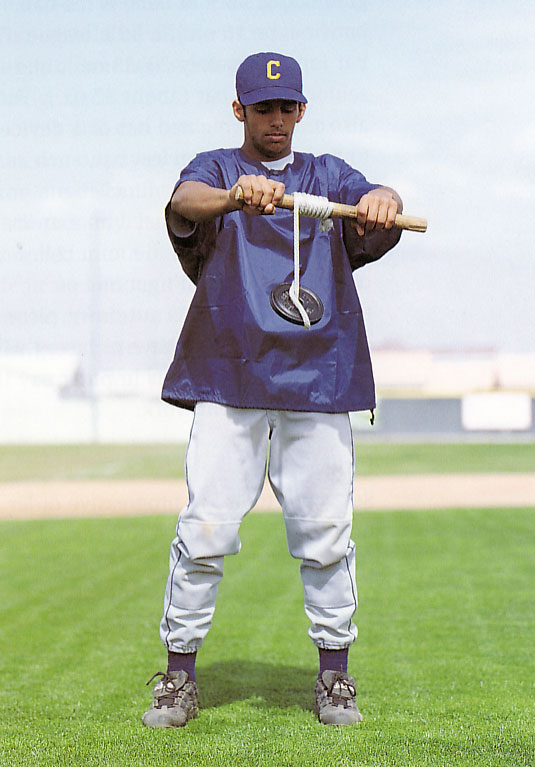
To develop a quick bat you must have strong hands, wrists and forearms. Some hitters are blessed with these attributes naturally. Others will need to work on getting stronger in this area. I will say this, if you have naturally strong hands, wrists and forearms, you would be silly not to improve on what you already have. You could be that much farther ahead of your opponent.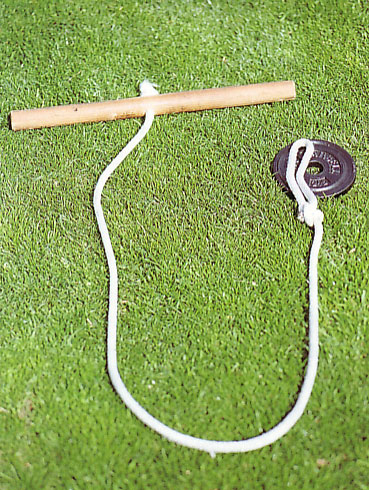
Have your father head to the hardware store and buy a piece of wood about 18″ long and approximately 3-4″ in circumference. It must be cylindrical. You also need about a 4′ piece of nylon rope. Drill a hole in the center of the wood and insert the rope. Tie a knot in the end of the rope to keep it from slipping back through. On the other end of the rope tie a loop. Go to your local sports equipment store and purchase a 2 ½ pound dumbbell plate and a 5 pound dumbbell plate. Slip the looped end of the rope through the center of the smaller plate and then slip the wood handle through the loop in the rope. You now have the perfect device to build strong hands, wrists and forearms. The entire device shouldn’t cost more than ten dollars to make. But it is invaluable to your development as a hitter.
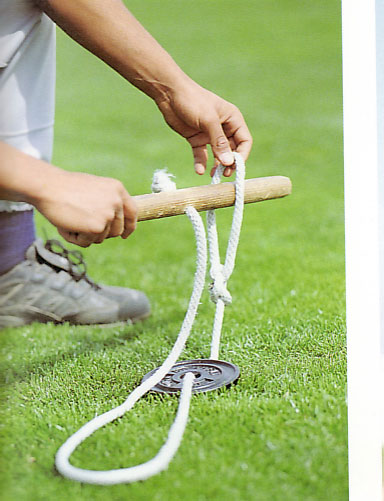
On Monday, Wednesday and Friday of each week for at least six weeks, spend at least fifteen minutes a day rolling the rope around the handle. Roll the weight up, then roll it back down (fig. 6-12). Take a break after each ten times you complete the sequence. If you find that the 2 ½ pound weight is too heavy, ask your father to buy you a 1 pound weight and switch weights. Work yourself up until you can switch back to the 2 ½ pound weight. You eventually want to be able to perform this exercise with a 5 pound weight attached. That is your goal. If you are very young it may take quite a while before you are capable of doing this. But. . .if you have the discipline, desire and dedication to keep at this until you can attach that 5 pound weight and complete the routine, your hands, wrists and forearms will become very strong.For about the first two weeks you will experience some muscle soreness in the forearms. That is natural. Your muscles are adapting to the workload. Forearms are very dense muscles used to quite a bit of activity, but this is different for them and they will need time to adjust. Stick with it and that soreness will be replaced by strength.

