
 I always get a kick out of listening to the parents of Little Leaguers when their child is at bat. “Swing level,” “Keep your back elbow up,” “Do this,” Don’t do that.” “Geez, Mom, hush up and let me hit!” Most kids would probably love to step out of the batter’s box and say that.
In reality, your swing must match the path of the baseball thrown by the pitcher as closely as possible, and for as long as possible, to successfully hit the ball. Pete Rose once said, “See the ball, hit the ball.” Once you have embraced the swing mechanics taught in the previous chapters, this is the proper approach. Let your swing take over. Swing the bat in the path of the ball, matching that path as closely as possible for as long as possible.
If all pitchers threw nothing but strikes for every pitch, and they were all the exact same height and thrown from the exact same arm angle, and all had the exact same release point, combined with the exact same speed, with the exact same rotation on the ball (which affects ball flight), then. . . and only then, could a hitter have the exact same swing plane every time and successfully hit the ball. To say nothing about the “timing” of the swing in relation to the speed and distance of the pitched ball. It’s no wonder that Ted Williams described hitting a baseball as “the single most difficult task in sports.” Studies have even been conducted by college physicists, who came to the conclusion that the batter is faced with tremendous odds for failure.
The key then, is to have a good swing that is repeatable and adjustable to the angle of the pitched ball. Since the pitcher is actually standing above you (on a mound) and he is throwing the ball from above his shoulder (most of the time), the ball will be traveling in a downward flight to the strike zone. Logically, the optimum swing plane for the bat would be a slight upswing to closely match the angle of the ball as it travels into the strike zone. Of course, this would be for the perfect strike.
Let me ask you this, how many times have you watched a baseball game on television and seen the batter hit a low, inside pitch over the wall for a titanic blast? The replays show the hit over and over and the commentator says something like, “Whoa, he went down and got that one,” or “He golfed that baby out of here, it looked like a 3-iron going out!” These are perfect examples of the hitter matching the plane of the pitched ball with his bat. If the batter had “swung level” at those pitches, it would be a swing and a miss, strike three!
Your job as a hitter is to “see the ball, hit the ball.” We have already grooved your swing so that it is mechanically proper. Trust it! Swing the bat in the direction the ball is coming.
I will say this, the longer you are able to keep the bat on the same path as the baseball, the greater the chance you are going to hit the ball hard. Probably over the fence, if you get it just right. Here is my philosophy on why. If you get the bat “on plane” early in the swing, it has more of an opportunity to accelerate to the ball, the longer it is accelerating, the faster the bat gets moving. The faster the bat is moving, the harder you will hit the ball. It is really pretty basic.
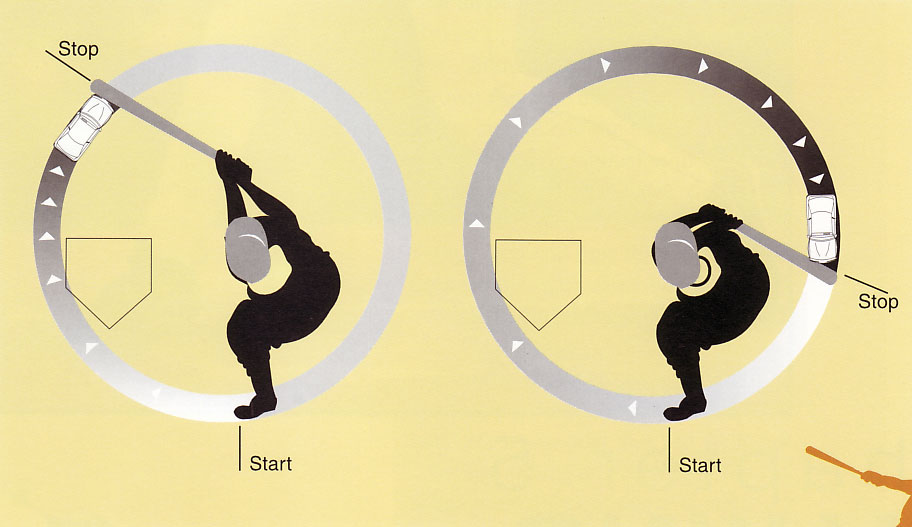
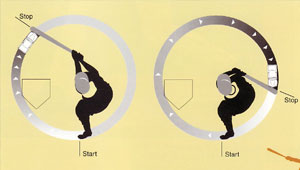
You only need to have the bat moving at approximately 75mph to hit a ball 300 feet. 75mph is really not that fast, honest. Ever watch a golfer swing a club? Pros can reach speeds around 120mph seemingly without effort. The swing we have built in the preceding chapters can easily reach 75mph on an average 14-15 year old boy. Most Major League fences are less than 400 feet away in dead center field! Of course, these numbers reflect a ball being pitched at Major League speeds (more on that later).
Again, get the bat “on plane” early in the swing. Whatever that “plane” is. Many a home run have been hit on balls pitched out of the strike zone. Once you have committed yourself to swing, give it a good rip. You have a good swing, hit the ball hard somewhere. If you miss, so what. You get three strikes, more if you foul a few off.
I am not advocating that you swing at any pitch. There are discussions elsewhere in this book pertaining to pitch selection. To be a successful hitter, you must be disciplined enough at the plate to swing at strikes, or what you believe are strikes. What I am trying to get across is that not every pitch is a strike, not every hit is a result of a ball pitched in the strike zone, and the batter that is best able to adjust his swing to the path of the ball, is the “good hitter” I want you to become.
Ted Williams, one of the most analytical hitters of all time, really broke down the science of hitting with one phrase, “Get a good pitch to hit!” If you have developed a good swing with solid fundamentals, the moment you see a “good pitch” coming at you, let that swing go and hammer the ball somewhere!
Review Overview


Hello, my 10 year old crushes the ball, this past 9u season, he led the team in all stats, he swings rotationally, he goes to a camp now , and the coach tells him to hit the top of the ball, he says he will never be able to keep up to high school speed swinging like he does. I don’t want him to change his swing, am I thinking right? Thank you Jeff
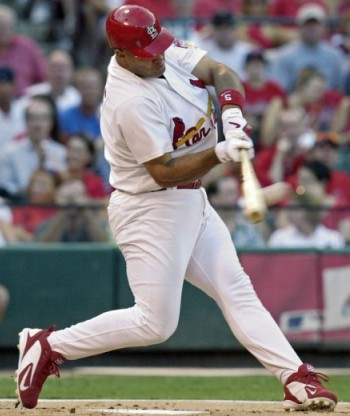
Coaches teaching to hit the top of the ball are usually old school. It is an older training myth that some baseball coaches still teach today. Watch videos of pros and notice how many are hitting the top of the ball. You want to match the path of the bat with the path of the ball and hit it square. Do you think Pujols is hitting the top of the ball in the image above?
With that being said, maybe your son is contacting the bottom of the ball currently and hitting a lot of popups that could be hard hits. If he focuses on hitting the upper part of the ball that may help correct an issue. So, maybe your coach is wrong and maybe not; it depends.