

By Coach Rob Ellis
Going for home runs, too many modern players pile up strikeouts instead of making contact with the pitch!
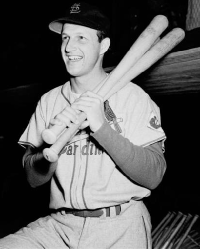 It was a monumental find. While pursuing my lifelong study of the skill of hitting, I discovered some old, dusty, 16 mm film footage of the great hitters of yesterday. One was titled, “Hitting Stars of 1943.” It featured Stan Musial, Ted Williams, Enos Slaughter, Dixie Walker, Ralph Kiner, Pete Reiser, Joe DiMaggio and at least a dozen others swinging the bat in slow motion.
Another one from the ’50s featured a rail thin Hank Aaron, a boyish Mickey Mantle, and slightly older versions of Williams and Musial. Each hitter swung the bat markedly different than today’s hitters. To the man, they displayed nearly a flat swing plane, flat wrist-roll and a low – rather than high – finish. This is vastly different from today’s hitters’ uppercutting arcs and high finishes. I hoarded the films, compiled them into a video and played them over and over.
After a thorough review, I embarked on some research in the Baseball Encyclopedia.
I found that over his 23-year career, Stan Musial struck out just 6.3 percent of the time, a phenomenal statistic for a slugger of 475 home runs. This is even more striking when compared with Ted Williams, generally considered the hitting maestro, who struck out 9.2 percent of his at-bats while slugging 521 home runs.
Through 1998 Mark McGwire had struck out 24.5 percent of his at-bats, Sammy Sosa 25.7 percent. A hypothesis was born. A comparison was required between the old sluggers, who in the films displayed flat, low finish swings, and today’s sluggers, who feature massive uppercuts with high finishes in terms of strikeouts and overall hitting efficiency.
| Old Sluggers | |||||
|---|---|---|---|---|---|
| Player | Ht. | Wt. | Career HR | K % | Career Avg. |
| Stan Musial | 6-0 | 175 | 475 | 6.3 | .331 |
| Ted Williams | 6-3 | 205 | 521 | 9.2 | .344 |
| Frank Robinson | 6-1 | 195 | 556 | 9.3 | .294 |
| Lou Gehrig | 6-0 | 200 | 450 | 9.9 | .340 |
| Hank Aaron | 6-0 | 160 | 755 | 11.2 | .305 |
| Billy Williams | 6-1 | 175 | 428 | 11.2 | .290 |
| Mel Ott | 5-9 | 170 | 511 | 13.1 | .304 |
| Willie Mays | 5-11 | 160 | 660 | 14.0 | .302 |
| Babe Ruth | 6-2 | 215 | 714 | 15.8 | .342 |
| Modern Sluggers | |||||
|---|---|---|---|---|---|
| Player | Ht. | Wt. | Career HR | K % | Career Avg. |
| Mark McGwire | 6-5 | 250 | 457 | 24.5 | .264 |
| Sammy Sosa | 6-0 | 200 | 273 | 25.7 | .264 |
| Ken Griffey Jr. | 6-3 | 205 | 350 | 16.7 | .290 |
| Albert Belle | 6-2 | 210 | 321 | 17.3 | .296 |
| Barry Bonds | 6-2 | 205 | 411 | 15.9 | .290 |
| Mo Vaughn | 6-1 | 240 | 230 | 24.9 | .304 |
| Jose Canseco | 6-4 | 240 | 397 | 27.0 | .286 |
| Frank Thomas | 6-5 | 250 | 285 | 16.3 | .321 |
| * Modern Slugger stats through 1998 season | |||||
This comparison clearly shows the old sluggers, using their flat-arc swings, struck out less and hit for higher averages.
Today’s sluggers were outdone by a wide margin in these categories.
Many reasons for this can be cited – today’s better pitching, night baseball, the travel demands, bigger, stronger pitchers. But when examined by the thinking man, other factors cancel their plausibility. For instance, better pitching is actually neutralized by expansion and the livelier ball.
Modern stadium lights blaring out high power wattage are at least equal to or in many cases, better than daylight. Quick air flight and divisional re-alignment neutralize the long, drawn out train travel from the early days.
Today, stronger, harder throwing pitchers are neutralized by stronger, faster swinging batters using lighter bats. Not only that, today’s hitters don’t have to face the likes of Death Valley Jim Scott’s spitter, or that of Urban “Red” Faber, who’s spitter came in at five different speeds.
Upgrade the old-timer’s meat and potatoes diet with one of scientific nutrition and supplements could give the modern players an edge.
Regarding all these hypothetical reasons for building a case why modern hitters strike out more than ever before, it is best to concede the following: For well over 100 years, the game of baseball has been governed by an invisible yet remarkable astute system of checks and balances.
This invisible hand has allowed the competitive balances to progress through the years as a constant. As per this system of checks and balances, it is reasonable to think that the diverse elements of the collective duel between the best pitchers and batters of yesteryear are remarkably, if not exactly, similar to today’s hitter-pitcher duel.
If the pitcher-hitter duels had changed, the game would require a fundamental rule change, which has never been required. (The only rule modification in the pitcher-hitter duel has been lowering the mound from thirteen inches to ten in 1969, an adjustment that would indicate the old-time pitcher, not the hitter, had the upper hand).
The game hasn’t changed. The rule has always been three strikes and you’re out. It is the hitter’s swing, specifically the arc that has changed.For further proof of the game’s pitcher-hitter duel remaining constant, in 1955 Hank Aaron struck out 10.1 percent of his at-bats. Twenty years later, his last full season, with the Brewers in a new league, he struck out 10.96 percent. A year earlier, 1974, he struck out 8.5 percent. Certainly if the pitchers had gained leverage over the hitter, it would have shown up during that 20-year span.
Yesterday’s sluggers had better hitting statistics because the arc of their swings made for more contact.
REASONS FOR THE FLAT SWING
Musial, Ted Williams, Aaron, and Frank Robinson emerged from an era when the strikeout was considered a humiliating defeat. Each strikeout tolled ultimate failure in the mano-a-mano duel with another competitor, the pitcher, and was something to be avoided at all costs.
Too many Ks meant the player was defeatable, that he hadn’t learned his trade and was not qualified for the big leagues. A player striking out on a scale to exceed 100 strikeouts annually couldn’t make it – he was farmed out quickly by managers who demanded the hitter move the runners with each at-bat, preferably with team hits – ground balls and line drives.
Excessive strikeouts were the mark of a hitter who hadn’t mastered his skill, who shouldn’t wear the major league uniform.
Today, it is not uncommon for middle infielders to approach or exceed 90 to 100 strikeouts.
Thus, for security reasons, the old-time hitter treated the strikeout like the plague. And, to get on the good side of the manager, he concentrated on moving runners with team hits – line drives and ground balls.
The formula was simple: hit line drives or ground balls, and avoid fly balls and strike three.
This was accomplished by swinging on the same plane as the incoming pitch – level plane, almost a chop, in order to deliver the bat on a linear collision course with the pitch. Players like Musial, Mays, Aaron and Gehrig mastered it.
Today, major league security seems to come not from avoiding the strikeout and moving runners with team hits, but by hitting double-figure home runs in order to sign a three-year deal for seven figures. This is best accomplished with a low to high uppercut, which gets the ball into the air, and finish like Tiger Woods watching a tall three-wood.
Today, any middle infielder authoring a dozen home runs annually is granted the leniency of 90 strikeouts. This makes the strikeout an acceptable part of modern hitting, rather than a statistical plague. And rather than being farmed out to perfect his skill, it is hoped he will learn on the job, for which he is getting paid handsomely.
I had the privilege of playing with Hank Aaron when I was with the Milwaukee Brewers in 1974-76
I clearly remember his unusually level swing plane. This was the reason for his nickname “The Hammer.”
He had a pronounced top hand action, like a hammer blow, which pounded the bat down through the strike zone, the head of his bat tracing out a remarkable level path. His home runs were largely long line drives, belted out with the level cut meeting the center of the ball and imparting backspin.
As a result, Aaron was more than just a home run hitter. He was an accomplished batsman who hit for average and minimized strikeouts. The same can be said for other hitters of his era Roberto Clemente, Ernie Banks, Al Kaline, Al Oliver, Ken Boyer, even Ted Williams.
The “uppercut” Williams used and recommended for home run hitters would be considered almost level when compared with the massive uppercuts used today by Mo Vaugh, Mark McGwire, Tony Clark, Frank Thomas, Sean Casey, Tim Salmon, among scores of others.
MECHANICAL PRECISION
Another reason tells why hitters emerging before the ’70s swung their bats on a level plane. They were weaned on dense, heavy bats, which required utmost mechanical efficiency to deliver the bat to the pitch on time. For efficiency, the shoulders, arms and wrists had to be pushed/pulled in a high to low action, identical to felling a tree with an axe. The entire torso, particularly the shoulders, had to be rotated directly at the target, not upward into an uppercut.
Today, bats are light as feathers. In his book, The Science of Hitting, Ted Williams talked about “modern” light bats shrinking to 34 ounces, while 1930s and ’40s players swung bloated 36 and 38-ounce bats. Now, in the current era, the average bat is below 32 ounces and getting smaller. The lighter the bat, the less efficiency required to swing it. Lighter bats allow for mechanical inefficiency (the uppercut with high finish) leading to mechanical inaccuracy, and with this comes the strikeouts.
Furthermore, today’s hitters are bred as amateurs on feather-weight aluminum bats with a sweet spot nearly the size of the entire barrel. Mechanical precision is not required to swing feathers.
With aluminum bats, mechanical precision can be (and is) sacrificed in favor of long, elliptical, golf-like mechanics, designed to get the ball into the air with a lot of excess whip.
To make matters worse, the majority of hitting coaches today are of the metal bat generation leaving them ignorant of mechanical precision required to deliver the bat on a level plane. Which is exactly why the secrets Aaron, Musial, Gehrig, and others used are lost – modern instructors never had to hit with the dense war clubs.
It may seem that hitting has never been better, with high averages and home run totals.
This is easily accounted for by two factors: the ball is livelier and the athletes are stronger.
(If the ball isn’t livelier, then the players’ strength has increased exponentially because the home run totals are through the roof. Television highlight clips consistently show off-balance, fooled hitters launching the ball into the outfield bleachers).
This increased strength factor allows the mechanical imprecision – the uppercut, which results in high strikeout totals. Stating it straight up, superman swinging a feather can appear to hit as effectively as “Joe Average” swinging with mechanical precision using a war club, except he’ll strike out a heck of a lot more. This is what is happening today.
No matter how you slice it, an uppercut may hit home runs but it will also strike out more and get less team hits. The proof of this statement lies in the comparison of the physical size of the older and modern player.
Study the relative height, weight, average, home runs totals and strikeout percentages in the table previously presented. Do you recognize the clincher?
The old masters hit for higher averages, struck out less, hit as many or more home runs than the moderns while hitting a deader ball, and were smaller in height and weight.
To do this, they must have hit the ball not only more often, but harder. This is overwhelming evidence in favor of the mechanically precise, flat arc swing of the older sluggers. Clearly, the older sluggers got as much or more mileage with less physical strength than today’s sluggers.
SIMPLE LOGIC
Musial, Aaron, Mays, DiMaggio, Ruth, Gehrig, all the successful players of the past, knew a few simple principles:
1. The fastball arrives from the pitcher’s hand to the strike zone, for the most part, on a straight-line path.
2. He, the hitter, must swing his bat on the same straight line as the pitch for maximum collision factor.
3. If his swing bisects the straight-line path of the fastball with an uppercut, contact is minimized.
These simple principles were put in play by DiMaggio, Dixie Walker, Vern Stephens, Ralph Kiner and nearly every other hitter featured in the vintage films. This is what they were doing. When viewed in slow motion, it almost seems like their bats are guided by invisible rails that keep it perfectly level.
Each Of These Rail-Straight Swings Are Characterized By Three Movements:
a. An angled (approximately 45 degree) approach of the bat from the stance position. As the arms and hands extend forward at this angle, the bat head lags behind, tracing out the level path to the contact zone.
b. After contact, the wrists execute a flat “roll over.” This flat rollover action serves to keep the bat on the level plane well after the ball has left the bat. The wrists do not roll upward into a silly, golf-type finish. This way, the rollover does not distort the end of the level path as it connects with the ball.
c. The level plane and wrist rollover continue into a low finish, at or below shoulder level.
With these skills, the old masters carved out a swing which neutralized any pitcher’s fastball, made for maximum collision with it, and thereby minimized strikeouts and hit the ball harder, more consistently.
These observations are not important to men the size of Mark McGwire, Frank Thomas, Jose Canseco, or the strength of Mo Vaughn and most of the 40-plus home run club. But for the average-size man or boy, like Aaron, Mays, Musial and 99 percent of the rest of us, the “old-time” mechanical efficiency is the secret to making the big leagues today!!!!!!!!!!
As a professional hitting coach who has worked with hundreds of minor leaguers, I cannot emphasize this enough. An average size man trying to swing like the big guys cannot pack enough power or consistency. The strikeouts and lack of team hits eventually eliminate him.
Mike Schmidt, who struck out a whopping 37 percent during his rookie year, acknowledged that he became a bona fide hitter and cut his strikeout totals in half by “swinging down on the ball”, something that came to him ten years into his career!
Schmidt stumbled onto this secret by imitating one-time teammate Dick Allen who, at 5-11 and 190 pounds, had two home run crowns and could hit the ball as far as anyone. Charlie Lau, a brilliant man who never advocated the high finish, said, “To produce a level swing, you have to get on top of the ball by swinging down at it,” precisely the thing Schmidt was talking about in his ground-breaking book on hitting.
Yet, my experience as a coach has shown me that remarkably few modern hitters employ either the logic or the movements to perform the level swing on a par with yesteryear. From my observation, I would say perhaps one out of six or seven major league players use precise mechanics bearing resemblance to the hitters of yesterday.
Some have had huge success. Paul Molitor was a fine example of the modern level cut, using the high-to-low approach, flat wrist roll and low finish. Carlton Fisk’s dramatic sixth game home run in the 1975 World Series is a perfect example of such execution, as is Aaron’s 715th home run.
Roger Maris’ home run swing is a perfect model, as is Schmidt’s 500th. George Brett’s “pine tar” home run is as good as it gets.
Today, Nomar Garciaparra, at a mere 6-0, 175 pounds, is an ideal model of those outdated hitting principles, and like Musial and Aaron, is putting up “big man” numbers.
Craig Biggio, at 5-11, 180 pounds, is another fine example, belting the ball on a par with bigger men.
Barry Bonds and Albert Belle model the level-cut principles very well as home run hitters, and their strikeout percentages back it up. All are getting maximum production from an ancient style of hitting, using time-honored principles.
They don’t have to be alone, now that the secrets are out. The skill of the level cut is remarkably simple to learn! All it requires is seeing the examples, shifting one’s hitting goal from fly balls to lien drives, & changing one’s physical paradigm from a “low-to-high approach” to”down-and-through” As Mike Schmidt knows, the results can be dramatic!
Review Overview


The truth is ,by slow mo video,the vast majority of pitches come in at a ten degree down tilt.The best on plane ,with the pitch,not the ground,swing, is a ten degree up tilt.The old timers understood this. This explains the up swing of Rogers Hornsby who started from the dirt up sometimes and greatly influenced Ted Williams who actually hitched down then came up to a tilted up swing around ten degrees.Jimmy Foxx lagged his bat in a flat plane and never swung down at a pitch going down,the very recipe for strikeouts.The V swing one point of intersection is the very thing taught by most coaches which is the recipe for pop ups and strike outs.
The hands go down (from the shoulder area) and the bat goes up at a 5-10 degree path.The hands stay above the ball and the bat attacks from slightly below the ball. Charlie Lau addressed this when he wrote in his second book, “swing down and finish high”. That’s Hank Aaron all the way! He appears to be swinging down because the ‘front part’ of his swing is so dramatically, down. But by the time his hands reach the center of his body his bat path begins to go up. The best shots of Aaron are the (few) side shots of him in Home Run Derby (filmed in the fall of 1959). He had a great attacking weight shift that was ‘back’ (stiff front leg to the outside of his front foot) as it appeared to be centered. His unusually strong bottom arm kept his swing “level”.
hank Aaron has a video where he describes how to hit. he says the top hand is the aiming hand and the bottom hand is the power hand. he starts the swing with the top hand and finishes with the bottom hand. good for contact hitting, line drives and high fastball coverage . you will need to go down and get the low ball as Hank demonstrates in the video.
There have been hitters that use the bottom hand as the guide and extend with the top hand leading to a high finish. this swing is good for low ball hitting but leaves leaves the hitter vulnerable inside and upstairs.
for most average size guys initiating the swing with the top hand and hitting up the middle will lead to success.
I do agree hitting with the heavy bat is totally different and getting it started with the dominant hand on top leads to level swing, more line drives and fewer strike outs.
Good read, I met Buck O’neal at an airport , we talked baseball and I told him that I thought that pro outfielders seem to lack reaction to the sound of the bat because they were brought up hearing aluminum ” clink” weather it be a bunt or a drive over there head. Wear as the guys brought up with wood bats would know where the ball is by the ‘crack” of the bat and would drift to the catch making it look easy. And B. O’neal agreed..what say you?