
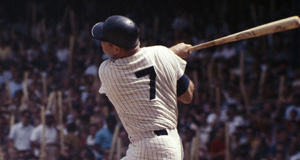
During the winter months I am frequently asked to speak at coaching clinics regarding hitting. One of my favorite lectures breaks the mechanical process of hitting into 7 steps. In this article, we will look at how I approach explaining the mechanics of the hitting. I like to look at the mechanics of hitting broken down into 7 steps as follows:
- Selecting a Bat/Holding the Bat
- Set-up/Stance
- Take Away, Back to Go Forward (Power Position)
- Forward is Stride to Hitting Position
- Rotation/Decision
- Swing or Release to Contact
- Contact to Finish, (includes follow-through)
For organizational purposes, this outline will be used to discuss the mechanics of hitting.
Selecting a Bat/Holding the Bat
The bat must fit the player. Three important variables in bat selection include handle size, weight, and length. When selecting a bat, the handle size should be comfortable to the hitter. The weight of the bat is the most important factor in choosing a bat. Choosing a light bat should increase bathead speed. Increasing the bathead velocity is the most important factor to imparting force to the ball as illustrated in the kinetic energy formula (energy of a moving object due to its mass and velocity) KE=1/2 mV2 . The kinetic energy of the bathead is directly proportional to the mass (weight) of the bat, while it increases by the square of the velocity. Thus, small increases in velocity will result in greater force applied to the ball than merely increasing the mass of the bat. Make sure the bat is not too heavy. Comfort and control are keys to bat selection. The player must swing the bat, not bat swing the player. The length of the bat affects plate coverage, but is not as important as selecting one of the proper weight.
The bat is held primarily with the last three fingers on each hand. Starting with the middle knuckles close to alignment is a good reference point. The bottom hand should be rotated counter-clockwise, while the top hand rotates clockwise. This action cocks the wrist, placing an angle in the back of the wrists (The small Power-V). The hands should be tension free. Tension in the hands spreads through the forearms and out through the entire body. The bat can be held with a choked, split, or lapped grip.
Set-up/Stance
The set-up and stance do not require a time element, so care can be taken to position yourself as you choose. This stage of the hitting process must free the hitter so he can move efficiently to other phases. One important point to keep in mind regarding stances- Extreme stances require extreme abilities! The further you vary from the norm, the more natural talent it takes to be successful. Extreme setups often can tip off good pitchers and coaches as to where exploitable weaknesses are. As I said in my first article, use the K.I.S.S. principle, Keep It Simple (and) Smart.
The stance should be taken so that the batter has an excellent chance to see the ball. Stances generally fall into one of three types, open, straight, or closed. There are certain advantages and disadvantages to each, but selection of a stance is more of a hitter preference. The weight should be forward on the balls of the feet. This can be accomplished by bending forward at the waist, and gently softening the knees. Bending the knees first, will place the weight back on the heels, reducing the lower bodies effectiveness in the swing.
When constructing a building, it is built on a good foundation from the ground up. Hitting is no different. A good stance is a combination of a body with a low center of gravity, supported by a wide base. The following factors should be present in a good stance:
Feet
The feet should be spread a minimum of shoulder width apart. The toes should be pointed slightly inward, with the weight carried on the inside balls of the feet. The heel of the stride foot (nearest the pitcher) should be up.
Knees
The knees should be flexed, well inside your feet. This is important to maintaining stability and balance.
Hips and Shoulders
The hips and shoulders should be level, with the spine almost vertical. This is important for maintaining Gyroscopic Stability (rotating about a single axis). Generally, rotational hitters are more vertical in their stance. Weight shift hitters are bent more at the waist. The front side can be turned in slightly, provided it does not create a vision problem.
Head
The head should be positioned so that the eyes are level and must remain still throughout the swing. The body rotates under a still, quiet head. It is important that the head be positioned so that both eyes can see the pitcher. Hitters should know which of their eyes is dominant. This is important because it can affect the type of stance and load they use. Right-handed hitters who are right-eye dominant must make sure the bridge of their nose does not restrict their ability to see with the back (dominant) eye. A good practice when first beginning is to hold your hand over the eye closest to the pitcher and rotate your head until you can fully see the release point with your back (dominant) eye. This will ensure “binocular” vision. Binocular vision is vital to proper information, allowing the brain to calculate depth, distance and speed. In essence it locates the pitch in space (triangulates a 3 Dimensional object). It cannot do this process with one eye (Monocular vision). So, turn your head!
Arms, Hands, and Wrists
The arms should be relaxed in and flexed, elbows in a “down and in” position. The hands should be held at the top of the strike zone, 3-6 inches from the back shoulder. From this position, they work from high to low. Keeping the hands closer to the body produces less rotational resistance. The wrists should be cocked as previously described.
You may be wondering, why is so much time being spent on the stance? The swing consists of a “link system” of levers that are used to generate force (bat speed). “To finish right, you must start right. You are only as good as the previous phase. ”
Take Away, Back to Go Forward (Power Position)
The take-away, or load, requires a hitter to move back before they can go forward. This puts the hitter into what I call the “power slot” position. The hitter’s first move should be back, away from the pitcher. This can be done in several ways. Over the years, I have had the opportunity to work with some great hitters. Many of these hitters use different ways to move the weight to the backside. Paul O’Neill used a “high knee lift”. Don Mattingly used a “sit to hit” approach, while Bernie Williams uses a “toe tap”. The method that a hitter uses is irrelevant, provided their weight moves back away from the pitcher, to the inside of the back foot (pivot foot). The purpose of the take away is to overcome inertia and get momentum for the swing. It places the weight slightly to the backside, making it easier to lift the front foot to stride, starting the next phase of the swing.
Stride to Hitting Position
The stride can be one of the biggest contributors to swing problems. The stride should be short, soft, and slow. The hands and arms must stay back, near the launch position. The stride must be separate from the swing. You step to hit, not step and hit. The forward movement of the stride foot should be made toward the pitcher. Leading with the heel and landing on the inside of the stride foot help keep the front toe closed, assisting the hitter in keeping the front side closed. A good hitter has slow feet and quick hands. The term “walk away from your hands” is used to reinforce keeping the hands and weight back. A hitter can never get into hitting position too early. The Weight/Wait concept is used to remind hitters to “keep their weight back and wait on the ball”.
Body Rotation/Weight Transfer Decision Starts
As the stride is finished, the torso begins to uncoil, thereby starting body rotation (angular outward rotation). Immediately, the legs start to provide force for developing bat speed. The lead leg firms up, pushing against the ground, forcing the front hip backward. The back leg pushes the back hip forward. As the backside starts to turn, the front side stays firm. The power generated is related to the speed of body rotation. Rapid rotation of the hips assists the hitter in maintaining balance (gyroscopic stability). The more vertical or upright position of the back and spine means the axis of rotation will be more perpendicular to the ground, resulting in increased stability. Keeping the hands close to the body conserves angular momentum. The hands start near the back shoulder (3-6 inches) and take a short path directly to the ball. The batter develops a great deal of energy through the rotation of the body. Keeping the hands near the body reduces the drag, allowing body rotation to occur faster. Keeping the hands near the body, allows a significant portion of this energy (torque) to be transferred to the bat as it rotates around the body and extends through contact.
Swing/Release to Contact
The backside is responsible for taking the bat forward, without the front side opening up. Hitters should hit their way through their front side. The bottom hand or lead arm starts the bat into the plane of the ball. The barrel stays above and behind the hands as the bathead approaches contact. The top hand finishes the swing by pushing the bathead through contact (mechanical couple). At contact, the wrists are square, with the bottom hand palm down, and the top hand palm up. The swing should continue “long through contact”. The head stays still and must look down to swing down. The swing plane changes constantly due to different contact points with different pitches. Everything else must remain the same.
The closer the pitch is to the hands (inside pitch) the farther out front contact must be made. The farther the pitch is from the hands (outside pitch) the longer the hitter can allow the pitch to travel. The hitter has less time on the inside pitch because the bathead must travel further, resulting in a longer swing. The hitter has more time on the outside pitch, because the bathead travels a shorter distance to contact, allowing the hitter to have more time.
Follow-through/What Gets the Ball in the Air
The follow-through is a continuation of the body rotation and swing. The single most important part of the follow-through is that it must be done. A good follow-through results from good swing mechanics. After contact, the body does not stop, but should continue until rotation and weight transfer is complete. The hands finish high, away from the body. The head and shoulders are over or near the front foot. The head should be down through contact and naturally follow the flight of the ball. The hitter should be short to contact, long through contact. At the finish, the hips are square to the pitcher, on the toes of the back foot.
Review Overview

