
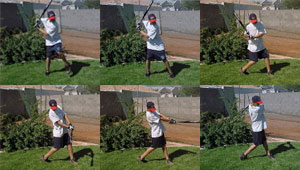
Everybody wants to be a great hitter. Most young players dream about hitting the ball like Alex Rodriquez or David Wright or Prince Fielder. What they don’t realize is that All-Star players like that have such deeply ingrained muscle memory built into their swing that they can totally forget about their swing and concentrate solely on hitting the ball. The swing just happens for them at this stage in their careers. They are literally seeing the ball and hitting it, automatically! Guess how they got to that point? Work! Swing after swing after swing, thousands and thousands of swings. Not just any swing, the right swing. Soft toss, Tee work, Batting Practice… swing after swing after swing. Eventually, they developed the muscle memory to the Sweet Swing. When their visual system recognizes a good pitch, the “swing” command from the neural system is given and the Sweet Swing happens.
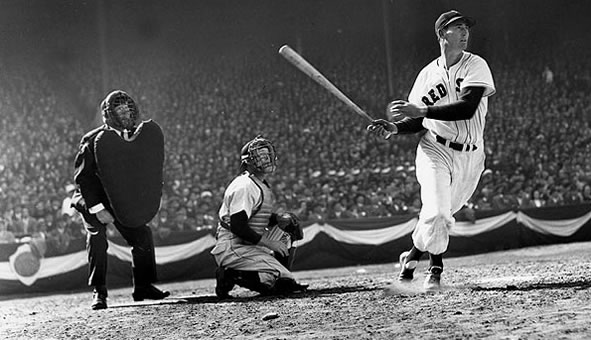 Does that mean that every swing results in a 450 foot homerun? No. There are many variables that affect success at the plate and those are for other discussions. What is important is that if you are fundamentally sound in the mechanics of the swing, you will have a greater opportunity to be successful in your at bats. The question is, Do you have what it takes to develop the Sweet Swing? In this article I will give you the proper mechanics of the Sweet Swing, broken down into six simple steps. Performing this swing thousands and thousands of times correctly is up to you. If you have the discipline, desire and dedication to ingrain these simple steps into muscle memory, you will be well on your way to becoming a better hitter. Ted Williams performed these exact same six steps back in 1941! The year he became the last MLB hitter to hit over 400!
Step 1: Loading
 Hey Coach! You forgot the stance position! Actually, no I didn’t. I purposefully left that position out. Look around the Major Leagues, there are hundreds of different stances, very few of them are similar. Everybody has their own comfort level, style and body type. If you have been playing baseball for any length of time you more than likely have a position which you feel most comfortable in, stay with that. Just make sure you get to a simple, proper load position similar to the one shown here in the photograph.
From this position the player is in a well-balanced, loaded position that allows him to attack the incoming pitch. Watch the Major League hitters. You will see most players reach this position at some point, no matter what their stance looked like when they started..
The key points to a good load:
 [checklist]
- The weight moves primarily onto the inner portion of the back leg and foot
- The front shoulder closes slightly, automatically loading the hands and tilting the bat head forward toward the pitcher (knob looks at the catcher)
- The front knee kicks inward (show the pitcher your pocket) this move cocks the hips
- The player is stacked, meaning from the bottom of the back side to the top everything is aligned
- The foot is under the knee, the knee under the hip, shoulder and hands stacked above the hip
[/checklist]
Step 2: The Step
 This is a much more critical portion of the swing than most people give credit to. The load stage gets the hitter in synch with the pitcher. The step stage gets the hitter in synch with the pitched ball. Which are you hitting, the pitcher or the pitch? See my point? Timing is the most important component in hitting. An excellent swing poorly timed will likely get no results. By contrast, a poor swing properly timed will likely result in success.
Moving the weight forward to the front leg causes the head to move forward as well. This is bad news for a hitter. The head must remain in the same location it was in during the load phase.
Time your step between the release point and about 10 feet from the pitcher. Early is much better than late. A late step makes it nearly impossible to hit. Remember, it is step then swing… not, step and swing. They are separate.
The importance of the steady head position cannot be overstated. When the head moves forward, the eyes move as well. The visual system is providing information to the brain relative to the ball’s position in space. When the eyes move forward it causes the brain (computing the incoming data on the ball) to calculate .. re-calculate.. calculate.. re-calculate regarding the point the player should intercept the ball with the bat. That is simply asking too much given the time frame. So, a steady head allows the brain to compute the information correctly the first time. Small step, weight back, steady head.
The key points to a good step:
[checklist]
- Short is sweet. 6-12″ is more than sufficient, some players simply pick the foot up and put it right back down. This depends on the width of your original stance
- Land softly on the pad near the big toe
- Keep the weight primarily to the rear leg – this is the “stay back” you always hear from coaches
[/checklist]
Step 3: Launch the Hips
 The third movement in the Sweet Swing sequence is the launching of the hips. This movement is the cornerstone of the power generated in a baseball swing. I have referred to this movement as the “coiling and uncoiling” in previous articles. The launching of the hips is the beginning of the torque phase of the baseball swing. The big muscles of the lower body (the hips and legs) are moving one way, while the big muscles of the upper body are ever so slightly moving the other way or remaining stationary… coiling against each other to create the powerful torque necessary for a Sweet Swing.
From this point in the swing sequence everything happens at super speed. It is almost impossible to distinguish the movements from each other because of the incredible speed generated from the proper hip action. It is imperative that you practice these movements in slow motion to fully ingrain the actions to muscle memory. Again, the head does not move! Rotate under the head. The hands not moving forward allows the player to react to the speed of the pitched ball. For a fastball, the player will obviously launch the hands almost immediately to time the contact. For an off-speed, the player simply waits for the ball to near the contact point before launching the hands. This is the “keep your hands back” command you hear so often from coaches. Ingraining this Sweet Swing to muscle memory makes that an automatic occurrence.
 The key points to launching the hips:
[checklist]
- The player fires the rear hip forward toward the pitcher
- The head does not move forward, everything rotates under the head
- The hands do not move forward (They will move a little on their own)
- The rear elbow tucks to the hip. This movement directs the knob of the bat toward the ball
- Most of the player’s weight remains on the rear leg with some weight moving to the firming front leg
[/checklist]
Step 4: Launch the Hands
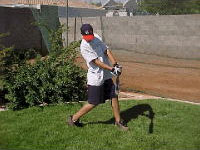 This is the only phase in the swing that most fans are aware of. They either see the player hit the ball or miss it when the player swings the bat with his hands. In actuality, if the player incorporates the previously addressed motions to muscle memory, this is the easiest part of the swing. Providing, of course, that the player has some measure of hand-eye coordination. Simply launch your hands at the ball… aggressively! This is no time to be passive, trust your hands and attack the ball. With the previous three steps already set in motion, the player has generated enough torque to propel the bathead at speeds matching or exceeding that of the pitched ball. The ball travels a total of 60 feet at those speeds, whereas the bathead travels only a handful of feet from the start of the swing to the point of contact. Great hitters are naturally more adept at this all important timing sequence. But the simple truth is confidence in your swing can play a tremendous role in your success.
Again, the last line is the key. The head stays steady. If the information provided by the visual system never changes you will have greater success in contacting the ball. Of course, the ball will move more in the last few feet. This is partially due to it losing speed and having gravity affect it’s path. This is why hitting is so difficult. The key is not to have information change (the brain computing where the ball and bathead will meet) as a result of anything the batter does. If information changes because of the talent of the pitcher throwing a moving fastball, or fantastic curve, so be it. Tip your hat. If the hitter keeps his head still and takes a short, linear approach to the ball, he has a better than average chance to succeed. Trust your hands.
The key points to Launching the Hands to contact:
[checklist]
- The knob driving toward the ball begins the sequence
- The wrists flick, or snap the barrel to contact
- The top hand is in a palm up position at the point of contact
- The bottom hand is in a palm down position at contact
- The front leg is firm and creates resistance for the body to propel the bathead
- The head stays steady
[/checklist]
Step 5: Extend (The Power V)
 The fifth step seems unnecessary. After all, we have already hit the ball. Isn’t that the object? Well, the key to being a good hitter is being able to hit the ball with authority. If you don’t power through the ball, you may as well bunt every time. You have to accelerate through the ball much like a boxer punches through a heavy bag. Contact is important, accelerating through the contact point is imperative.
This sequence is taking place at such incredible speed it is hard to imagine. By slowing it down to this stop system we can see how important the little aspects are in creating the levers and fulcrums that generate the force propelling the bathead at such amazing speeds. Most important to note is that the centrifugal forces we generated from the earlier hip action are what is actually whipping the bathead through the zone. The hands are actually opposing forces on the handle, creating even more torque! If a player were to release the bat it would fly a tremendous distance. How many times have we seen a bat fly into the stands 80-100 feet away after slipping out of the player’s hand? This is a result of the centrifugal forces generated with the Sweet Swing mechanics.
 The key points to the Power V:
[checklist]
- The hands do not roll over
- They finish their flicking motion started at contact
- Centrifugal force powers the bathead through the zone
- The front leg firms up and straightens out creating leverage for the bathead to swing around
- The player’s head looks directly down the ‘V’, chin down
- Some players lift off the rear foot as a result of the tremendous centrifugal force generated by the bathead, transferring even more body weight through contact
[/checklist]
Step 6: Extend Again (Finish the Swing!)
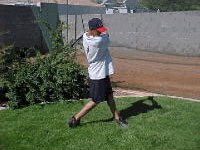 Here is where the hands finally roll over. The wrists are required to roll in order to re-direct the forces from their final stage of centripetal motion (directly out the barrel head at the Power V position) to centrifugal again (around the body). This wrist rolling also allows the bathead to decelerate more naturally. If the wrists were to remain firm it would act as a brake to the bat and the player would lose power and distance. The famous Charlie Lau theory was to release the top hand to prevent the bathead from decelerating as a result of this resistance. This created more extension in the swing and, according to some experts, more power to the baseball. Problems occur when most young player’s release too soon and therefore lose vital control of the bathead’s path. Most great power hitters of the past had a more natural finish around the body. Ted Williams, Hank Aaron, Mickey Mantle and Babe Ruth, just to name a few, had this type of finish to their swing.
The great announcer Vin Scully has a wonderful saying about players that have warning track power; balls that don’t quite get over the fence for a homerun. “One more biscuit for breakfast and that baby is gone!” Well, you can find that “one more biscuit” in your finish. Don’t decelerate the bathead after you hit the ball. Continue powering through the ball and let the bat wrap around your back before it stops. I think you’ll find some extra power there that can make a difference between a homerun and a ball caught at the wall.
The key points to a good finish:
[checklist]
- The top hand rolls over
- The bottom hand rolls over and the wrist collapses
- The hands finish at the shoulder or just below
- The bathead wraps around the back of the hitter
[/checklist]
We are talking about a very short time frame here… less than half a second. But ingraining the muscle memory into these steps of the swing will insure that the player executes them in the proper sequence during that short time span. Repetition will mold the steps into one Sweet Swing. Practice them in stop form one phase at a time: Load-stop, Step-stop, Hips-stop, Hands-stop, Power V-stop, Finish-stop. Progress to slow motion movements where the stops have less time in between them. Do this slow motion swing over and over and over in proper sequence. Go back to the stops. Over and over and over. When you find yourself out of synch during BP or Soft Toss, go through your steps in slow motion to remind your body of the proper sequence to a Sweet Swing.
Review Overview


Great tutorial
Good stuff. Timeless tips. Thanks
TIMELESS INDEED. CHARLIE LAU.
Great info. I’m looking for something I can use while at practice. A sort of pocket version with the highlights I can reference during practice without having to read the entire article.
the baseball swing should mimic throwing a ball sidearm. the bottom arm and hand should be a limp noodle. the swing should be generated by the top hand.