
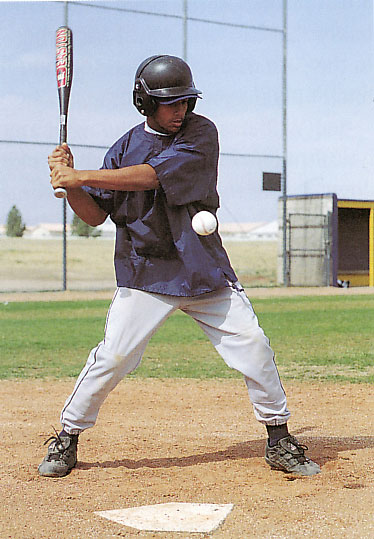
 The swing is grooved, the concept of matching your swing plane with that of the pitched ball is clear and understood. The next step in the act of successfully hitting a pitched baseball is timing. Timing your swing so that it meets the ball at the proper impact point, at just the right moment. Not a moment too soon, not a moment too late. Hall of Famer, Warren Spahn, while speaking of pitching, actually gave great insight to the art of hitting when he made the statement, “Hitting is timing, pitching is upsetting timing.” Hitting is timing! That seems too simple. How could it be so easily defined? I’ll tell you, because Mr. Spahn was referring to Major League hitters and Major League pitchers. People who should have the mechanics of their particular skills committed to muscle memory! There is no need to discuss “the attacking position”, the stiff front side, balance, swing plane, the follow through, or any other mechanical function of the swing (except to fix a flaw). Hitting is timing! The swing is muscle memory. Hopefully, we have accomplished establishing the swing into your muscle memory via the other articles on this website. Or, at the least, you are well on your way to developing a proper swing into your muscle memory. At any rate, this is the time to begin understanding the art of hitting, not swinging. The art of hitting begins with timing.
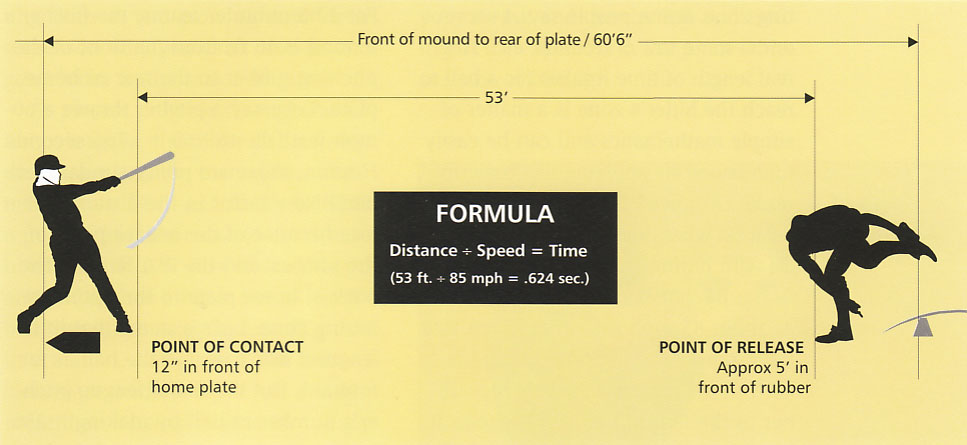
 Let me start with describing the time frame of a pitched ball into the hitting zone. I have read numerous books on hitting and just about everyone gives a different time for the ball to leave the pitcher’s hand and travel into the hitting zone. Some people say .4 seconds, some say .5 seconds, etc. The real length of time it takes for a ball to reach the hitter’s zone is a matter of simple mathematics and can be easily understood by applying this basic formula: Distance divided by Speed equals Time. Okay, what does all of this have to do with hitting a baseball? Let’s see…
If a pitcher is throwing a fastball at about 85mph on a regulation size field, where the pitching mound is 60’6″ from the front of the rubber to the rear of home plate, then it would take .485 seconds for the ball to reach the catcher’s mitt, if the ball were released exactly 60’6″ from the mitt. Since that is highly improbable, other factors need to be taken into consideration when determining how long it takes for a pitch to reach the hitting zone. Consider this, most pitchers actually release the ball from their hand approximately 5 feet in front of the rubber. Using that number, let’s subtract it from the 60’6″. Now, we have a distance of 55’6″. The time it takes for the ball to travel that distance at 85mph is .445 seconds. We lost about .04 seconds there, but that’s not all. Consider that the approximate point of contact is about 12″ in front of the front leg (assuming that the front leg is in line with the front of home plate) and that the plate itself is 17″ deep. Hmmmm, 17 plus 12 is 29 inches, for simplicities sake, let’s call it 30″, or 2 ½ feet. We are now down to a distance of 53′. At 85mph it takes a ball approximately .425 seconds to go from the pitcher’s hand to the hitting zone. These are Major League type of numbers.
Let’s look at Little Leaguer’s times: For 12 and under teams, the pitcher’s mound is 46 feet from the front of the pitching rubber to the rear of home plate. Let’s say a pitcher throws a 60mph fastball; 46 divided by 88.1fps = .522 seconds. Hmmm, those are pretty similar numbers! Okay, factor in the distance we lose because of the release point of the pitcher, and the 2 ½ feet from the back of home plate to the optimum hitting zone. Let’s assume that Little Leaguers don’t release the ball as far forward and cut that number in half, make it an even 2 ½ feet. That means we subtract 5 feet from the 46 feet and get 41 feet. Now, 41 feet divided by 60mph equals .465 seconds. Wow, that is only about .04 seconds different from the Major League formula. You know what that tells me? If you are a good hitter in Little League, and you continue to improve your swing and hitting skills as you grow older, there is no reason why you can’t also be a good hitter in the Major Leagues. Of course, pitcher’s get smarter and craftier and more capable of deceiving the hitter. Remember Warren Spahn? “Hitting is timing, pitching is upsetting timing.”
As players progress through the different leagues, the distance between the pitcher and the batter gradually increases to 54 feet and finally to 60 feet and 6 inches. The formula remains the same however, and it is easy to see that the amount of time a hitter has to see the ball, recognize it’s trajectory, calculate that information, pass it on to the muscles, react and swing, is just a little less than a half of a second.
More math, the average human reaction time is 3/4 of a second. That’s .750 seconds. What does that mean if a player simply reacts to the ball from the time it is released? That’s right, if you are good at math, you figured it out. Go have a seat on the bench, strike three went right on by you before you could even swing. Hitting is timing. A batter must begin his swing at the same time the pitcher begins his motion. There is an old saying, and I am not sure which hitting instructor first said it, “When the pitcher shows you his pocket, you show him yours.” In other words, when the pitcher kicks his front leg up to begin his delivery to the plate, the hitter should begin his “cocking” or “pre-swing” motion, preparing the bat for a swing at the ball. If he does not, it is physically impossible to react in time.
Learning how to time your swing is the art of hitting. If you work hard at developing a good swing by following the principles outlined in previous chapters, you have the makings of a good hitter. Understanding your swing, and the rhythm and timing of it, in relation to the pitch speed and location is the essence of hitting.
Ideally you would like to contact the inside pitch a few inches in front of the front leg. This allows the bat to accelerate into the ball and the arms to fully extend immediately after contact. To envision the proper hitting position, imagine a boxer standing close to his opponent and delivering a powerful punch to his opponent’s midsection. The hip is rotated, the hand is facing up and the elbow is close to his body. Shortly thereafter the arms extend, which transfers a tremendous amount of power into the ball. This position, sometimes referred to as the “Power-V,” is the ideal position to be in directly after the point of contact. Again, I will refer you to your favorite Major League hitter’s baseball cards. Flip through them until you find him in the point of contact with the baseball. I’d be willing to bet you see him in this “punching” position. Followed by the “Power-V” position; arms extended, chin down, top hand not yet rolled over, eyes on the ball. Can you imagine the speed that bat is traveling through the hitting zone? Mark McGwire’s bat speed has been clocked at 98mph! Couple that with the impact of a ball thrown at 90mph or more, it’s a wonder the ball is not physically out of round after suffering such a crushing blow! 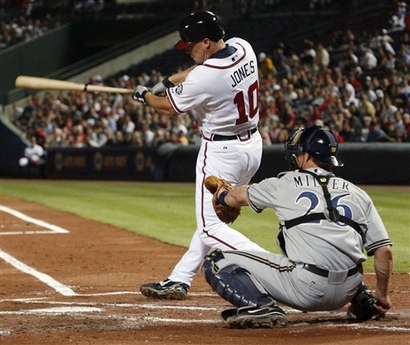
There is really only one way to develop the proper timing of your swing: batting practice, batting practice and more batting practice! Preferably against live pitching and not a machine. Machines are good and serve the purpose if used properly. They can help you develop your swing and introduce you to a moving ball, but to really learn the timing of your swing, you need to see the motion of a pitcher and his arm, rhythm and release point.
The drills referred to on this website are outstanding for grooving your swing, fixing flaws in your swing, and developing the ability to hit the ball to various areas of the baseball diamond. But. . . hitting is timing and in order to develop the sense of timing in your swing, you need to see live pitching. As much as possible, whether it be during practice or games, you need to see pitching and hit against pitching.
HittingStore.com has an incredible product we invented to assist in developing the timing in a hitter; The XLR8 Speed Balls. These Speed Balls fly at different speeds with the same arm speed – just like live pitching! The difference is anybody can throw these and have a changeup as nasty as Tom Glavine!. Your father, brother, sister, Mom.. heck even your Grandma can throw batting practice to you with the XLR8 Speed Balls. Check the Hitting Store link above or simply click on the image below to check these out.
Some how, someway, hit against a pitched ball. Develop timing. Hitting is timing.
Review Overview


A quote from your article–“A batter must begin his swing at the same time the pitcher begins his motion.”
If the pitcher throws hard, you’re late. If the pitcher throws soft, you’re early. How can that be a timing solution? The answer to be “on” every fastball is simple, yet very few people know. A few old time great hitters understood and taught the young players who asked questions and implemented the responses. Timing the fastball is easy, hitting it consistently hard and where no one is standing is not. The real essence of hitting lies in controlling the knob of the bat to take care of the inside, outside, and offspeed pitches. I was bored, and you probably think I’m crazy–you’d be correct.
I think he was simply saying that he “begins his swing.” He didn’t say he swings through, or that contact with the ball would be made. He only said “begins.” The motion of the beginning of the pitchers pitch, should be mirrored with beginning of the batters swing. I think it’s after that, only after that initial movement, that the batter would have to determine the rest.
Third to last paragraph of this article starts with: “The drills referred to earlier in this book…” — which book is this referring to?
Thanks,
-RJ
This article was originally written in a book called “Be A Better Hitter” – we will update the post since the book is no longer published.
good article, but more information is needed