
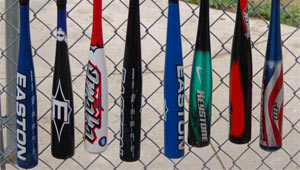
One of the most important factors in a young player’s success at the plate isn’t just mechanics or practice time; it’s swinging the right bat.
I’ve watched countless talented hitters struggle because they’re fighting their equipment instead of the pitcher. The bat feels like an anchor. Swing speed vanishes. Contact suffers. Confidence craters.
Here’s the brutal truth: Too many well-meaning parents buy their kid a bat that’s the wrong length, wrong weight, wrong certification, or all three. The result? Another obstacle between your player and success.
Let me ask you something: Have you ever watched your kid step into the box with a bat that’s clearly swinging them instead of the other way around? That slow, labored hack that arrives late every single time? That’s not a mechanics problem; that’s an equipment problem.
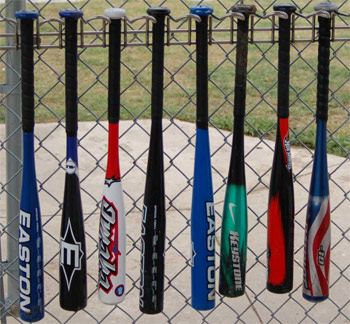
Whether you’re buying your first tee ball bat or transitioning to the mandatory -3 BBCOR in high school, this is your complete guide to choosing a bat that actually helps you HIT.
Not the bat that looks cool. Not the one your teammate uses. The one that’s RIGHT for you.
Quick Answer: What Does the Negative Number on a Bat Mean?
The negative number on a baseball bat (-10, -8, -5, -3) is called the drop weight or length-to-weight ratio. It tells you how many ounces lighter the bat is compared to its length in inches.
Simple formula: Bat Length (inches) – Bat Weight (ounces) = Drop Weight
Example: A 30-inch bat that weighs 20 ounces = -10 drop
(30 – 20 = -10)
What it means for your swing:
Higher negative number (-12, -11, -10) = Lighter bat = Faster swing speed = Easier for younger/smaller players
Lower negative number (-5, -3) = Heavier bat = More power potential = Better for older/stronger players
The negative number is the MOST important spec when choosing a bat. Get it wrong, and your swing speed disappears.
Step 1: Know Your League Requirements (Or You’ll Be Ejected)
Before you fall in love with any bat, you need to know what’s LEGAL in your league. This isn’t optional; show up with the wrong certification and you’re done before you even swing.
USA Baseball Standard (Youth Baseball – Ages 4-14)
If you’re playing Little League, Pony, Dixie Youth, Babe Ruth, or any sanctioned youth baseball up to age 14, your bat MUST have the USA Baseball certification mark.
This standard went into effect January 1, 2018, and it completely changed youth baseball. The old “hot” USSSA bats that sent balls screaming? Gone. The USA Baseball standard brought youth bat performance much closer to wood bat performance; for safety and to develop actual hitters, not just ball launchers.
What You Need to Know:
Look for the USA Baseball logo stamped on the bat
- Barrel diameter limit: 2⅝ inches maximum
- No length limit (though practical range is 24″-34″)
- Drop weights: Typically -10, -11, or -12
- Old USSSA 1.15 BPF bats are ILLEGAL in these leagues (those are only for tournament ball now)
Required leagues: Little League, Babe Ruth, Pony Baseball, Dixie Youth, Cal Ripken
BBCOR Standard (High School & College – Mandatory)
If you’re playing high school or college baseball, your bat MUST be BBCOR certified with a -3 drop weight. No exceptions.
BBCOR (Batted Ball Coefficient of Restitution) has been mandatory since January 1, 2011 for NCAA and January 1, 2012 for NFHS (high school). It limits the “trampoline effect” to bring performance closer to wood bats.
What You Need to Know:
- Look for the BBCOR .50 certification mark
- MUST be -3 drop (a 33″ bat weighs 30 oz., a 32″ bat weighs 29 oz.)
- Barrel diameter: 2⅝ inches maximum
- These bats feel HEAVY compared to -10 youth bats; this is intentional and mandatory
The -10 to -3 transition is where most players struggle. Plan ahead.
USSSA (Travel & Tournament Ball)
If you’re playing USSSA tournament baseball (travel ball), you’ll use the USSSA 1.15 BPF standard. These bats offer significantly more pop than USA Baseball bats and come in various drop weights.
What You Need to Know:
- Look for the USSSA 1.15 BPF mark
- Barrel diameter: 2¾ inches maximum (bigger than USA/BBCOR)
- Drop weights available: -5, -8, -10, -12
- These are the “hottest” legal bats in youth baseball
- Most competitive travel teams use USSSA bats
At 14U, many USSSA tournaments require -5 or BBCOR bats to prepare players for high school.
Step 2: Understanding Drop Weight (The Number That Changes Everything)
Every bat has a drop weight: -10, -8, -5, -3. This tells you how many ounces lighter the bat is compared to its length in inches.
Formula: Bat Length (inches) – Bat Weight (ounces) = Drop Weight
Examples:
30″ bat, 20 oz. = -10 drop
32″ bat, 27 oz. = -5 drop
33″ bat, 30 oz. = –3 drop
The bigger the negative number, the lighter the bat feels.
What Does the Negative Number on a Baseball Bat Mean?
You’ll see these negative numbers stamped on every bat: -10, -8, -5, -3. That’s the drop weight, and it tells you the bat’s swing weight profile.
Think of it like this:
- Higher negative number (-12, -10) = Lighter bat = Faster swing speed = Better for younger/smaller players
- Lower negative number (-5, -3) = Heavier bat = More power potential = Better for older/stronger players
Why negative? The minus sign shows you’re subtracting weight from length. A -10 bat is significantly lighter than a -3 bat of the same length – that’s why leagues mandate different drop weights by age.
What does minus 10 mean on a baseball bat? It means a 30″ bat weighs 20 ounces (30 – 20 = -10). This is the most common drop weight for youth baseball because it gives younger players the bat speed they need without requiring adult strength.
Drop Weight Recommendations by Age/Level:
Tee Ball (Ages 4-6): -11 to -13
Youth Baseball (Ages 7-10): -10 to -12 (USA Baseball certified)
Youth/Travel (Ages 11-12): -10 to -12 (USA Baseball or USSSA)
Transition (Ages 13-14): -8 to -10 (USSSA preferred, some use -5)
Pre-High School (15-16): -5 (critical transition year)
High School & College: -3 MANDATORY (BBCOR)
Swing Weight vs. Actual Weight: Why Two Bats Feel Different
Here’s something that confuses the hell out of parents at the batting cage: You hand your kid a 30-ounce balanced bat and they rip line drives. Then you give them a 30-ounce end-loaded bat and suddenly they’re swinging a telephone pole.
Same weight. Completely different swing feel.
This is called Moment of Inertia (MOI) – a physics term that basically means “how hard is it to swing this bat through the hitting zone?” And it’s determined entirely by where the weight sits in the bat.
Think of it like this: Hold a hammer by the handle and swing it. Easy. Now flip it around and hold it by the head. That’s way harder to swing even though the hammer weighs the exact same amount. That’s MOI.
Balanced Bats:
- Weight distributed evenly throughout the bat
- Lower MOI = Faster through the zone
- Better bat control and quicker hands
- Perfect for contact hitters who need to adjust mid-swing
- Feels lighter than the actual weight
End-Loaded Bats:
- More weight concentrated in the barrel
- Higher MOI = Harder to swing
- More mass behind the ball at contact = more power potential
- Better for power hitters with strong, developed swings
- Feels heavier than the actual weight
Here’s the kicker: A 31-ounce balanced BBCOR bat can legitimately feel lighter and swing faster than a 30-ounce end-loaded bat. I’ve watched it happen a thousand times in the cage.
When you’re testing bats, don’t just look at the drop weight stamped on the barrel. Ask if it’s balanced or end-loaded. For younger players and contact hitters, always go balanced. For older power hitters who can handle the extra mass, end-loaded can add that extra 5-10 feet of carry.
But remember: Bat speed always wins. If the end-loaded bat is slowing you down, it’s the wrong bat no matter how much “power potential” it has.
Is a -10 or -8 Bat Heavier?
This trips up parents constantly: A -8 bat is HEAVIER than a -10 bat of the same length.
The smaller the negative number, the heavier the bat:
- 30″ at -10 = 20 oz. (lighter)
- 30″ at -8 = 22 oz. (heavier)
- 30″ at -5 = 25 oz. (even heavier)
- 30″ at -3 = 27 oz. (heaviest)
Think of the negative number like a discount – the bigger the “discount” (-10), the more weight you’re removing.
The -10 to -3 Transition: Why It Breaks Players
Here’s what that jump actually means:
A 13-year-old using a 31″ bat at -10 = 21 ounces
Same kid at 14 in high school using 31″ bat at -3 = 28 ounces
That’s a 7-ounce jump. Swing speed plummets. Timing falls apart. Confidence craters.
The smart approach: Use -8 at age 12-13, then -5 at age 14-15, THEN go to -3 for high school. Your body needs time to adapt. I’ve watched talented kids who crushed with -10 bats struggle for an entire season with -3 bats because nobody prepared them for the weight difference.
Remember: Bat speed is king. Always choose the lightest drop weight that’s legal for your age and league. Never sacrifice bat speed to look “older” or “stronger.”
Step 3: Composite vs. Alloy (The Technology Battle)
Modern bats use two primary materials, and understanding the difference matters.
Alloy (Aluminum) Bats
Pros:
- Ready to use immediately; no break-in period
- More durable in cold weather (composites crack below 60°F)
- Generally less expensive ($150-$300)
- Consistent performance throughout lifespan
- Better for contact hitters
Cons:
- Smaller sweet spot than composite
- More vibration on mishits (the “sting”)
- Less trampoline effect at peak performance
Best for: Younger players, colder climates, budget-conscious buyers, contact hitters
Top 2024-2025 Alloy Bats:
- Marucci CAT X / CAT X2
- Louisville Slugger Atlas
- Easton ADV 360
- Rawlings Velo
Composite Bats
Pros:
- Larger sweet spot across entire barrel
- Superior trampoline effect = more exit velocity
- Less vibration = better feel
- Lighter swing weight when properly engineered
- Multi-piece construction optimizes performance
Cons:
- Requires 150-200 hit break-in period
- Cannot be used below 60°F (will crack)
- More expensive ($300-$500)
- Some leagues restrict composite bats
Best for: Advanced hitters, warm climates, players wanting maximum performance, power hitters
Top 2024-2025 Composite Bats:
- Louisville Slugger Meta / Meta Prime
- Easton Hype Fire
- Rawlings Icon
- DeMarini The Goods
Hybrid (Two-Piece) Bats
Composite handle + alloy or composite barrel. Best of both worlds: reduced vibration with durability and quick break-in.
Step 4: One-Piece vs. Two-Piece Construction
One-Piece Bats
Barrel and handle made from single piece of material.
Feel: Stiff, direct feedback, maximum energy transfer
Best for: Contact hitters, players who barrel the ball consistently, traditional feel preference
Examples: Marucci CAT X, Louisville Slugger Solo
Two-Piece Bats
Barrel and handle are separate pieces connected with advanced technology.
Feel: Reduced vibration, “whip” through the zone, more forgiving
Best for: Power hitters, players wanting max barrel speed, those who hate sting
Examples: Louisville Slugger Meta, Easton Hype Fire, Rawlings Icon
Modern connection technology (3Fusion, Connexion+, VCX) has gotten so good you barely feel the separation; you just get the benefits.
Step 5: Finding Your Perfect Bat Size
This is where most people screw up. Here’s how to get it right.
The Standing Test (Quick Check)
Stand the bat next to you. The knob should reach the center of your palm when your arm hangs naturally at your side.
The Arm Extension Test (Weight Check)
- Hold bat by knob with your top hand (right hand for righties)
- Extend arm straight out to your side, parallel to ground
- Can you hold it steady for 30-45 seconds without shaking or dropping?
- If NO = too heavy or too long
- If YES = you’re in the ballpark
The BEST Test: Live Swings
Take your player to a batting cage with multiple demo bats. Hit 15-20 balls with each option at game-speed velocity.
Watch for:
- Does the swing look smooth or labored?
- Is the barrel arriving on time?
- Are they consistently barreling balls?
- Do they look CONFIDENT?
The right bat makes your kid look like a hitter. The wrong bat makes them look like they’re chopping wood.
The Three Physical Tests Every Parent Should Know
Before you spend $300 on a bat, run these three quick tests right there in the store or cage. They take 30 seconds and they’ll tell you instantly if you’re in the ballpark on sizing.
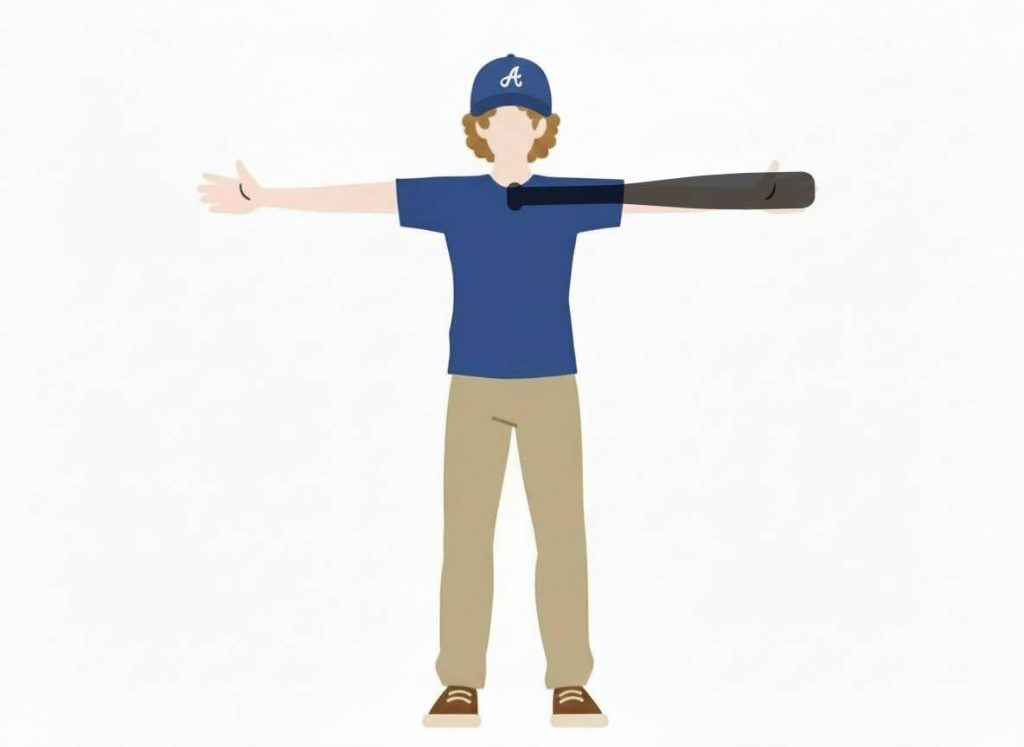
Test #1: The Arm Extension Measurement
This is your starting point for bat length.
- Stand with your arm extended horizontally from your body, parallel to the ground
- Measure from the center of your chest to the tips of your outstretched fingertips
- That measurement = your bat length starting point
Example: If that measurement is 30 inches, start testing with 29″, 30″, and 31″ bats.
Why it works: This naturally accounts for arm length and body proportions. A 5’2″ kid with long arms needs a different bat than a 5’2″ kid with short arms.
Test #2: The Standing Ground Test
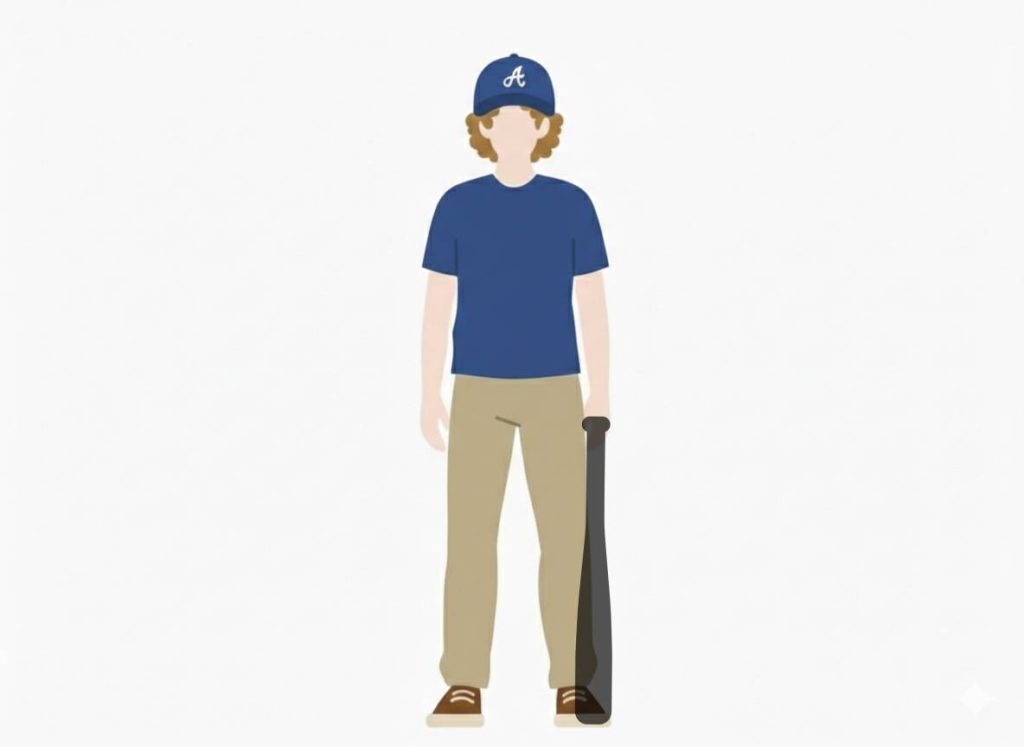
This confirms the bat isn’t too long.
- Stand the bat upright next to your leg
- Place the knob at the center of your palm with your arm hanging naturally at your side
- The bat tip should just touch the ground
- If it’s more than 1-2 inches off the ground = too short
- If you have to tilt it to reach = too long
Why it works: If the bat is significantly off the ground when the knob is centered in your palm, your leverage points are wrong.
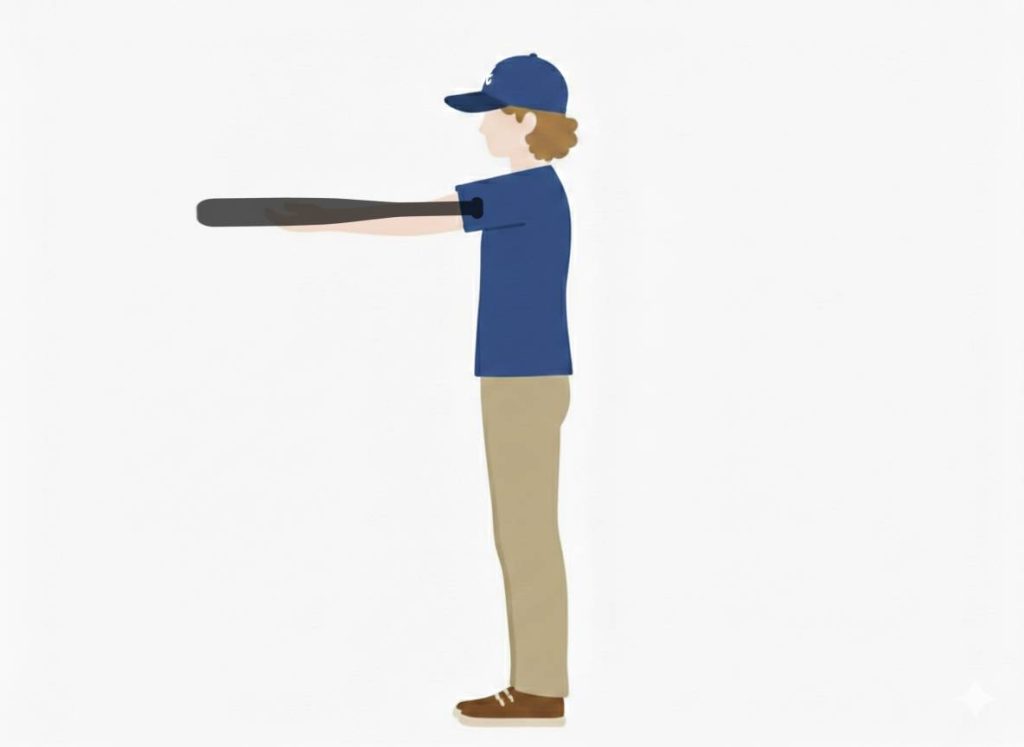
Test #3: The Barrel Reach Test
This is the final confirmation.
- Hold the bat handle at the center of your chest
- Extend the bat straight forward (like you’re offering it to someone)
- Can you comfortably reach the barrel end with your other arm?
- Yes = correct length range
- No = too long
Why it works: This simulates the extension and reach you need during your swing. If you can’t reach the barrel in this static test, you won’t have good bat control in a dynamic swing.
Combine All Three Tests
Use Test #1 to find your length range (29″-31″), then use Tests #2 and #3 to confirm. If all three tests check out, NOW run the arm extension weight test we talked about earlier (hold bat straight out for 30-45 seconds).
The goal: Find the lightest bat in the correct length range that passes all three physical tests.
These tests work because they account for individual body proportions, not just age or generic height/weight charts. I’ve seen 12-year-olds who need 31″ bats and 12-year-olds who need 29″ bats – same age, completely different builds.
Now you’re ready to hit the cage with 2-3 finalists and see which one produces the best ball flight.
Bat Sizing Chart by Age/Height/Weight
Ages 5-7:
Height 3’5″-4’0″ → 26″-27″ bat
Height 4’0″-4’5″ → 27″-28″ bat
Ages 8-10:
Height 4’6″-4’8″ → 28″-29″ bat, 17-19 oz.
Height 4’9″-5’2″ → 29″-30″ bat, 18-20 oz.
Ages 11-13:
Weight 70-90 lbs → 29″-30″ bat, 19-20 oz. (-10)
Weight 91-120 lbs → 30″-31″ bat, 20-22 oz. (-10 or -8)
Weight 121-150 lbs → 31″-32″ bat, 22-24 oz. (-8)
Ages 13-15 (Transition):
Weight 100-130 lbs → 31″-32″ bat, 26-27 oz. (-5)
Weight 131-160 lbs → 32″-33″ bat, 27-28 oz. (-5 or -3)
High School & College:
Height 5’6″-5’10” → 31″-32″ bat, 28-29 oz. (-3)
Height 5’11”-6’2″ → 32″-33″ bat, 29-30 oz. (-3)
Height 6’3″+ → 33″-34″ bat, 30-31 oz. (-3)
The Best Bats for 2024-2025 Season
Best Youth USA Baseball Bats
Louisville Slugger Meta (-10) – Two-piece composite, massive barrel, moderate swing weight
Easton Hype Fire (-10) – Hot out of wrapper, balanced feel, great value
Marucci CAT X (-10) – One-piece alloy, durable, affordable, consistent
Rawlings Velo ACP (-10) – Hybrid construction, good all-around performer
Price range: $150-$350
Best USSSA Travel Ball Bats
Easton Hype Fire (-8/-10/-5) – Composite rocket, balanced, requires break-in
Rawlings Icon (-5/-8/-10) – Huge barrel, ultra-light swing, zero-loss collar technology
Louisville Slugger Select PWR (-10) – Hybrid, hot alloy barrel, great value
DeMarini Zoa (-10) – Consistent barrel performance, all-composite design
Price range: $200-$450
Best BBCOR High School/College Bats
Louisville Slugger Atlas (-3) – One-piece alloy, balanced, hot out of wrapper, no break-in
Marucci CAT X2 (-3) – One-piece alloy, light swing, durable, excellent value
Rawlings Icon (-3) – Two-piece composite, massive barrel, balanced swing
DeMarini The Goods (-3) – Two-piece composite, power hitter’s bat, end-loaded
Easton ADV 360 (-3) – Two-piece composite, speed-optimized, great feel
Price range: $250-$500
Wood Bats: Why You Should Care
Wood bat leagues are EXPLODING at every level; MSBL, college summer ball, showcase tournaments, and youth training.
Why Wood Bats Matter:
- They expose swing flaws immediately – can’t muscle through with metal
- They teach sweet spot hitting – tiny 2-6″ sweet spot vs. 10″+ on composite
- College scouts LOVE wood bat showcases – shows true hitting ability
- Many elite tournaments require them – where recruiting happens
- Makes you a better hitter – period
Wood Bat Types:
Maple: Hardest, most durable, tightest grain, least forgiving – 75% of MLB uses this
Ash: Lighter, more flexible, larger sweet spot, breaks easier – old school classic
Birch: Middle ground between maple and ash, “seasons” over time to become harder
Composite Wood (BBCOR): Wood exterior with composite core – best of both but expensive
Pro tip: If your player is 13U+ and serious about baseball, get them a wood bat for off-season training. It will transform their barrel awareness. Start with -3 birch (same drop as high school).
Common Bat-Buying Mistakes (Avoid These)
❌ Buying based on what another kid uses – Their swing ≠ your swing
❌ Buying a bat “to grow into” – Your player needs success TODAY, not next year
❌ Ignoring league certification requirements – Instant ejection
❌ Not testing before buying – Would you buy a car without driving it?
❌ Choosing cheap over right – A $100 bat that doesn’t fit is more expensive than a $300 bat that does
❌ Using composite bats in cold weather – They WILL crack below 60°F
Price Ranges & When to Spend
Entry Level ($75-$150):
Perfect for recreational players, first-time buyers, or players still growing. Solid performance without breaking the bank.
Mid-Range ($150-$300):
Sweet spot for most players. Last year’s top models and current mid-tier bats. Excellent performance at reasonable prices.
Premium ($300-$500+):
Top-of-the-line with latest technology. Worth it for serious year-round players who can appreciate performance differences.
Pro Tip: Buy last year’s flagship model when new versions release. Save 25-40% for nearly identical performance.
Your Action Plan: Choosing the Right Bat TODAY
- Identify Requirements:
- Age/level
- League certification (USA, BBCOR, USSSA)
- Legal drop weight
- Budget
- Narrow Length Options:
- Use standing test and arm extension test
- Get within 1-2 inches
- Test Live:
- Go to cage with multiple demo bats
- Hit 15+ balls with each
- Trust your eyes and ball flight; not specs
- Make the Investment:
- Buy from retailer with return policy
Register for warranty
Break in composite properly (150-200 hits)
- Maintain It:
- Don’t use composite below 60°F
- Store in temperature-controlled area
- Clean after each use
- Never use with worn batting cage balls
Frequently Asked Questions About Bat Numbers
What is the negative number on a baseball bat?
The negative number (-10, -8, -5, -3) is the drop weight. It shows how many ounces lighter the bat is compared to its length in inches. A -10 bat that’s 30 inches long weighs 20 ounces (30 – 20 = -10).
What do all the numbers on a baseball bat mean?
Baseball bats display several numbers:
- Length: Measured in inches (28″, 30″, 33″, etc.)
- Weight: Measured in ounces (usually shown as drop weight)
- Drop Weight: The negative number (-10, -8, -5, -3)
- Barrel Diameter: 2¼”, 2⅝”, or 2¾ inches
The drop weight (negative number) is the most important for choosing the right bat.
Is a -10 or -8 bat heavier?
A -8 bat is heavier than a -10 bat of the same length. The smaller the negative number, the heavier the bat. For example:
- 30″ bat at -10 = 20 ounces
- 30″ bat at -8 = 22 ounces
Can a 12-year-old use a -3 bat?
Technically yes, but it’s not recommended. A -3 bat is significantly heavier and designed for high school players and above. Most 12-year-olds should use -10 or -8 bats for optimal bat speed and control. Using too heavy a bat will destroy swing mechanics.
What drop weight should my child use?
Follow these general guidelines:
- Ages 7-10: -12 to -10
- Ages 11-13: -10 to -8
- Ages 13-14: -8 to -5
- Ages 15+: -5 to -3
- High School/College: -3 (mandatory)
When in doubt, go lighter. Bat speed is more important than bat weight for developing players.
Why do high school players have to use -3 bats?
High school and college require -3 BBCOR bats to ensure performance is similar to wood bats. This creates fairness, improves safety, and prepares players for professional baseball where only wood bats are allowed.
The Bottom Line
Choosing the right baseball bat isn’t about the most expensive bat or the coolest paint job. It’s about finding the bat that allows YOUR swing to be at its best.
Too many players are fighting their equipment when they should be fighting the pitcher.
Remember this: The lightest bat you can swing with authority at the proper length will ALWAYS outperform a heavier, longer bat that slows you down.
Start with the right certification. Test live with game-speed pitching. Trust the process. And when you find that bat; the one that feels like an extension of your arms; you’ll know immediately.
Now get out there and crush the mistakes.
Got questions about specific bats or need help choosing? Drop a comment below and I’ll help you find the right fit.
Review Overview


This article is out of date and should be taken down. High school and College players swing -3’s not -5’s. -5’s have not been swung in ages.
Yes, this article is outdated, but instead of taking it down we should update it. If you would like to contribute that would be great!
The article might be outdated, but some of the principles are still the same. Bat control at a younger age regardless of mandated bat drop is definitely key. My son has recently moved to the mandated drop 3 from drop 5 and decided to go with a shorter bar which also decreased weight by an ounce to achieve better bat control. Very informative and a good read. Some things maybe to add would be swing weights determined by MOI (moment of inertia) and how a heavier bat could swing lighter because of the weight distribution.
So my son just started 6th grade and hes playing baseball. He only weighs about 75 lbs. His coach told him to get a 3 lb bat, but when I go to the stire im seeing anything that says 3 lbs. What am I looking for to get the right bat?
3 lb bat makes no sense. Maybe his coach meant to say a -3oz. drop bat? I would clarify with the coach directly if it were me.
Article has been updated!
Exactly, a 3 pound bat would dent/break with one soft toss hit
Unless its literally just a short metal tube
You do realize that bats are measured in ounces correct? A 3 pound bat would be 48 ounces…
48 oz is about as heavy as what Babe Ruth swung his day…they don’t make a bat heavier than 34-36oz these days. Anyway, he needs a -12 (drop 12) or -10 at the heaviest because he’s a bean pole.
I’d suggest a 16oz, 28 in bat or a 18oz, 30in bat or some variation close to that.
What would a bat -12.5 relate to in ounces?? 16 oz??
Rob – It depends on the length. If a bat is a -12.5 then subtract 12.5 from the length to find the weight. If it is a 33 inch bat, the weight would be 20.5oz.
I’ve been told my son will need a -5 drop bat to play 13u travel. Is this true? since I’m shopping bats and -5 bats are far few and between..I know high school requires -3 drop but I’m thinking going from -10 to a -3 might be a huge difference and transitioning with a -5 drop could be a good thing anyway…
These charts are meaningless. My six year old played in a U7 Coach Pitch league. He was the only kid in the league using a wood bat (he insisted). It was a 28″ and I weighed it at 21.7 oz. He was one of the best hitters in the league.
wood bats aren’t the same as metal-aluminium bats. They probably have different requirements for wood bats making it look heavier.
What’s meaningless is your belief that one specific player, your son, invalidates a chart meant to be used for the average player. Think before you post.
Exactly, Thank you Scott for posting that, you beat me to it. Burnt son.
I have a 10 year old that stands 5’4” and goes 170#. We’ve spent numerous dollars because he’s killing the ball. He plays in the Minor division but just cleared 210 feet fence in a Major field!! He’s denting every bat we buy him! He’s practicing with a 32” wood Rawlings Big Stick but we got him an Easton -8 450 and he dented that too!! I was looking for a heads up on what kind of bat would be somewhat indestructible for him?? Barrel has to be no bigger than 25/8ths inches but need some weight because he’s always hitting to left or left center field,so his timing is on. Please help if you can??
Really wish you would talk wood bat, nobody uses metal bats anymore not counting school ball, most if not all amateur leagues have a wood bat rule due to people being badly injured or even killed by metal bats, its an abomination that needs to be outlawed period. Be that as it may most of us wood bat users can never find any good advice about wood bats, very frustrating. I play in the MSBL it is huge nationwide.
Article has been updated!
I have never seen one kid using a wood bat in ANY league. I’ve seen countless games of all ages and even coached early teens. Maybe it’s different depending on the area, but in Georgia, I’ve never seen a kid use a wood bat.